
A grease trap problem grows fast in a working kitchen. One slow sink during prep turns into standing water, strong odors, and a backup that stops service.
Most restaurant grease trap problems follow the same pattern. The trap fills faster than it gets cleaned. Grease moves into the drain lines. The kitchen then loses time and money to downtime.
This guide covers the problems that show up most often, the signs staff should report immediately, and what actually fixes them.
Key Takeaways
- Slow drains, odors, and backups are the earliest warning signs.
- Overflow and repeated backups usually mean the trap or the lines need professional attention.
- Cleaning the trap alone does not always clear grease that has already coated the pipes.
- Staff habits and a realistic pumping schedule prevent most emergencies.
- Hydro jetting is often required when problems return after a recent pump-out.
What Are the Most Common Restaurant Grease Trap Problems?
The issues that disrupt kitchens most often include grease trap overflow, persistent foul odors, slow sinks and floor drains, kitchen drain backups, and grease or wastewater appearing around the trap. These problems usually share one root cause: fats, oils, grease, and food solids building up faster than the system can handle.
A trap that is full, undersized, or overdue for service stops separating FOG effectively. Once that happens, grease continues downstream and creates larger drainage problems.
Signs Your Grease Trap Needs Cleaning
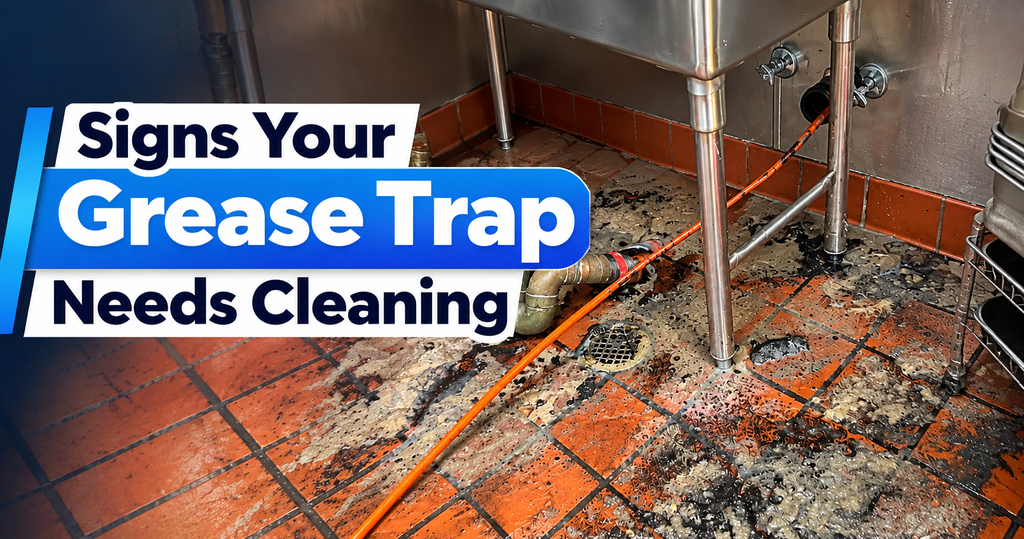
Kitchen staff are usually the first to notice changes. These signs should be reported the same day they appear.
Slow kitchen sinks and floor drains
Water that used to clear quickly begins to linger. Pot wash sinks, prep sinks, and floor drains take longer to empty, especially during peak service.
Persistent foul odors
A strong smell near sinks, floor drains, or the dishwashing area often means food and grease are breaking down inside the trap. Odors that return soon after cleaning point to a deeper issue.
Visible grease or heavy solids
Grease floating on the surface or heavy solids packed inside the trap reduce capacity. When the grease layer is high, the trap is already past the point of efficient operation.
Grease trap overflowing
Wastewater or grease rising out of the trap is an immediate problem. It creates sanitation risks and can force the kitchen to stop using connected fixtures.
Repeated drain backups
Backups that return after recent cleaning usually mean grease has moved beyond the trap into the drain lines.
Grease or wastewater around the trap
Any pooling around the lid or base signals the system is no longer containing FOG properly.
What Causes Restaurant Drain to Back Up
Most restaurant drain backups start with one or more of these factors:
- The grease trap is full or overdue for pumping
- Too much food solid waste is entering the system
- Grease has coated the kitchen drain lines beyond the trap
- The trap is undersized for the kitchen’s current volume
- Cleaning schedules do not match actual FOG output
For recurring commercial drainage issues, a Drain Plumber Sherman Oaks CA assesses the affected fixtures and drainage path instead of treating every backup as a grease trap problem.
What Happens If a Restaurant Grease Trap Overflows?
An overflow pushes grease and wastewater back into sinks, floor drains, or the area around the trap. Staff must stop using affected fixtures, protect food and equipment, and deal with cleanup under time pressure. The longer the overflow continues, the higher the risk of contamination, customer impact, and health inspection issues.
Overflows are almost always preventable with timely pumping and proper monitoring. Once they happen, professional service is required to restore safe operation.
Gurgling Sound From Restaurant Drain: What Does It Mean?
Gurgling usually means air is trapped or flow is restricted inside the drain line. In a commercial kitchen it often signals grease buildup, a partially blocked section, or a system that is struggling to move wastewater.
Gurgling that appears with slow drains or odors should not be ignored. It is frequently an early sign that a more serious backup is developing.
How to Diagnose a Recurring Restaurant Grease Trap Problem
Recurring backups need more than repeated drain clearing. The first step is to find where the restriction is and why it keeps returning.
1. Identify Which Fixtures Are Affected
Check which sinks, floor drains, dishwashing areas, or other fixtures are showing slow drainage or backups.
- One fixture affected: The restriction may be localized.
- Several fixtures affected: The problem may involve a shared drain line.
- Sinks and floor drains affected: The restriction may be farther downstream.
This pattern helps narrow down where to investigate first.
2. Check the Grease Trap
Inspect the trap’s buildup, flow, visible condition, and recent cleaning history.
A heavily loaded trap needs cleaning. If the trap was recently serviced but drainage problems continue, the restriction may be beyond the trap.
3. Check the Downstream Drain Line
Grease does not always stop accumulating once it passes through the trap. Buildup inside connected drain piping can continue to restrict flow.
If the trap is clean but restaurant drains remain slow or keep backing up, inspect the downstream line before repeating the same trap cleaning.
4. Inspect the Pipe When the Cause Is Unclear
When recurring symptoms do not point to an obvious blockage, a drain plumber Sherman Oaks service can help identify the actual condition inside the line.
Inspection can reveal:
- Grease or sludge buildup
- Blockages
- Pipe damage
- Offsets or other flow restrictions
- The location of the affected section
5. Match the Service to the Problem
The treatment should address the source of the restriction, not just the symptom.
- Trap buildup: Grease trap cleaning or pumping
- Localized blockage: Professional drain cleaning
- Heavy grease buildup inside suitable piping: Hydro jetting
- Structural pipe damage: Pipe repair or replacement
- Recurring problems: Further assessment of system capacity, configuration, usage, and maintenance
For recurring grease buildup in connected restaurant drain lines, provides a way to thoroughly clean suitable piping and remove buildup that basic drain clearing may leave behind.
Frequently Asked Questions
How often should a restaurant grease trap be cleaned?
Most commercial kitchens need pumping every 1 to 3 months. High-volume kitchens often need monthly service. Pump when the trap reaches about 25% full, whichever comes first.
Why does my restaurant still have slow drains after the grease trap was cleaned?
Pumping removes grease from the trap but does not always clear grease already coating the drain lines. When problems return quickly, the lines usually need professional clearing.
Why does my commercial kitchen smell even after cleaning the grease trap?
Odors often come from decomposing material still present in the trap or in the connected pipes. A weak lid seal or rapid refilling of the trap can also bring smells back quickly.
Can I clean a restaurant grease trap myself?
Daily habits like scraping plates and using strainers belong to the kitchen staff. Full pumping and proper disposal should be handled by licensed professionals.
What should I do first if the restaurant grease trap overflows during service?
Stop using the affected sinks and dishwashers if possible, keep staff and food away from standing wastewater, and call for professional service. Running more water usually makes the backup worse.
When is hydro jetting needed for restaurant drain problems?
Hydro jetting is often required when the trap has been cleaned but slow drains, gurgling, or backups continue. That pattern usually means grease has built up inside the kitchen drain lines.
Need Help With Restaurant Grease Trap or Drain Issues?
Grease trap problems do not improve on their own. Every day of delay raises the risk of a full backup and higher repair costs. If your kitchen already has slow drains, odors, overflows, or backups that return after cleaning, stop waiting.
Call now to schedule service. We diagnose the trap and the lines, tell you exactly what needs to be done, and restore drainage with minimal kitchen disruption.